
It's Syllabus Season
Furman faculty should consider adding a statement supporting free speech to their syllabi.

Announcements:
⏳ Twelve weeks, no committee. On May 18, Furman’s Board said it would “soon” establish a presidential search committee and share details “in the coming weeks.” Twelve weeks later there is still no public committee, no named search firm, and no search website.
📊 Survey results coming. Our College Pulse survey of Furman alumni is almost complete and we’ll be publishing the results soon!
🎓 The Class of 2030 arrives. More than 700 freshmen move in this month, Furman’s largest incoming class in over a decade.
💰 “Clearly Furman” wrapped in June, reportedly raising more than $500 million against an original goal of $426 million. Congratulations for exceeding the goal! We’ll be watching how it’s spent.
📱 Follow us. We’re making a serious effort to be more active on LinkedIn and we’d love if you would follow us here: https://www.linkedin.com/company/furman-free-speech-alliance
Furman Trivia:
More than 700 freshmen arrive on campus this month. After Furman’s first principal resigned in 1828, how many students were left?
A) 84
B) 3
C) 11
D) 41
*Find the answer at the bottom of the newsletter!*
Syllabi Say the Quiet Part Out Loud
Later this month, Furman students will return to campus, move into their dorms, and get ready for the fall semester. Classes officially begin on August 26 and the first day will be spent, as always, reading the syllabus. In most college courses this is treated as a procedural formality before the real work begins, but it shouldn’t be. The syllabus is the one document that tells students, in advance, what a course and a professor expect of them: what they’ll read, what they’ll be asked to think about, and whether they’ll be free to disagree.
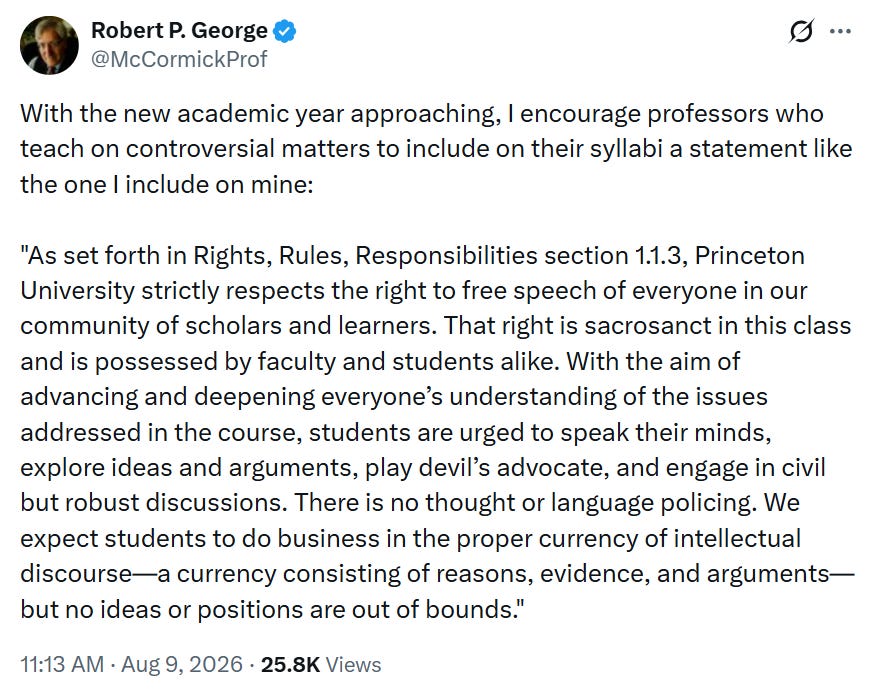
For this reason, legendary Princeton professor and founder of the James Madison Program Robert George recently encouraged professors, especially those who teach on controversial topics, to include a statement on their syllabi making it clear that they support free speech. For example, George states that “With the aim of advancing and deepening everyone’s understanding of the issues addressed in the course, students are urged to speak their minds, explore ideas and arguments, play devil’s advocate, and engage in civil but robust discussions.”
We hope Furman professors will follow his lead this August and adopt a similar statement. Doing so is especially important as many syllabi today lean heavily to the left. In “Closed Classrooms? An Analysis of College Syllabi on Contentious Issues” — a working paper discussed at Heterodox Academy’s 2026 West Coast Regional Conference at UC Berkeley — Claremont McKenna political scientist Jon Shields and two colleagues used a database of millions of syllabi to examine how three contested issues are taught.
On racial bias in the criminal justice system, the Israeli-Palestinian conflict, and the ethics of abortion, they found that students are overwhelmingly assigned the dominant progressive text without its most serious critics. For example, Michelle Alexander’s The New Jim Crow is found in more than 5,000 syllabi. James Forman Jr.’s Locking Up Our Own, the Pulitzer-winning book rebutting it, is assigned alongside it about 3.5% of the time. On the other hand, when Forman is assigned, Alexander’s book appears with it about 82% of the time.
This kind of bias in the syllabi can create a chilling effect on free speech from the very first day of class. Indeed, Shields and his colleagues suggest that moderate and conservative students may quietly opt out of overly politicized courses on controversial topics, creating echo chambers in the classroom just like the ones we find in our national politics.
Obviously, the best solution is to fix the syllabi by assigning a more balanced array of voices, but in the absence of doing that, simply making it clear in the syllabus that professors support free speech, as Professor George suggests, can help set a positive tone for the rest of the semester.
This may be especially needed at Furman.
We have raised concerns about the lack of ideological diversity among Furman’s faculty before. We have pointed out that nearly 98% of Furman faculty campaign donations in the 2023–24 cycle went to liberal or Democratic causes, according to City Journal. In FIRE’s 2026 College Free Speech Rankings, Furman ranks 213th of 257 on “Openness,” which FIRE attributes to persistent discomfort with viewpoint diversity. In that same survey, 9 out of 10 students said there was at least one topic, such as abortion or racial inequality, that they found difficult to discuss openly and honestly on campus.
With that in mind, and with great hope that even small changes — like inserting a simple free-speech statement on every Furman syllabus — can make a big difference, here’s what we’re calling for:
Furman faculty, adopt Professor George’s statement, or create your own version of it, between now and when classes start.
Furman students, read the dang syllabus and don’t be afraid to ask whether opposing views will be assigned or respected. And let FFSA know about biased reading lists!
Alumni, send us (furmanfreespeech@gmail.com) any memories you have of what Furman’s syllabi were like when you attended! We’d love to compare and contrast them with courses today.
Trivia Answer: B) 3 — Furman’s first classes commenced on January 15, 1827, in Edgefield. The first principal, Dr. Joseph Andrews Warne, resigned after just a year, and the student body diminished to a mere three students.