


Welcome back to the Data Din.
A sharp, visual snapshot of key data about Furman University. We took the summer off, but classes are back and so are we.
Last summer, Fitch Ratings moved Furman’s credit outlook from Stable to Negative. We covered it here at the time. The agency praised Furman’s balance sheet but flagged what it called an increasingly vulnerable enrollment demand profile and pointed to a specific number: 571 undergraduate deposits in April 2025, down from 621 the year before.
One year since that warning, we’re taking a look at how Furman has responded. But before we get into the data, we have a major announcement!
Take Our Alumni Survey!
The Furman Free Speech Alliance (FFSA) is working with College Pulse to field an independent survey of Furman alumni. Our goal is to figure out what alumni really think so we can present those views to Furman’s administration.
Here are a few examples of questions we’re asking:
When you attended Furman, how would you have described the university’s overall political and cultural environment? How would you describe it now?
Would you recommend Furman University to a prospective student today?
How responsive is the administration to concerns raised by students, parents, alumni, and others in the campus community?
Is Furman headed in the right direction or the wrong direction?
We don’t know what the answers will be, but we’re going to publish the results in full, no matter what they say.
The survey is anonymous, it only takes a few minutes, and it closes this week. If you’re an alumnus, please consider taking the survey here.
The Good, the Bad, and the Ugly of Furman’s Enrollment Situation
The Good
One year since Fitch called Furman’s credit outlook into question, the good news is that the university took the warning seriously and responded effectively. One of Fitch’s chief concerns was Furman’s enrollment, which had fallen steadily over the past decade. The administration answered that directly by enrolling Furman’s largest freshman class in over ten years — many of whom arrived on campus in the past few weeks.
Now, we have reported on how that turnaround was largely outsourced to outside consultants and driven by unusually aggressive tuition discounting — so much so that the larger class isn’t expected to generate much more net tuition revenue than recent smaller ones. And we’ve heard from a number of you in the comments, questioning the merits of chasing enrollment at all and asking how far standards might have to fall to fill a class this size.
These are legitimate concerns. But we should give credit where it’s due. The bottom line is that a leading global credit rating agency raised a specific alarm about Furman’s enrollment, and the university moved immediately to address it.
The Bad
The bad news is that it will take a lot more than just one large freshman class to reverse Furman’s enrollment trends. Data from the South Carolina Commission on Higher Education — the state’s authoritative annual compilation of enrollment, degrees, and finance data for every college in South Carolina — can help us explain why.
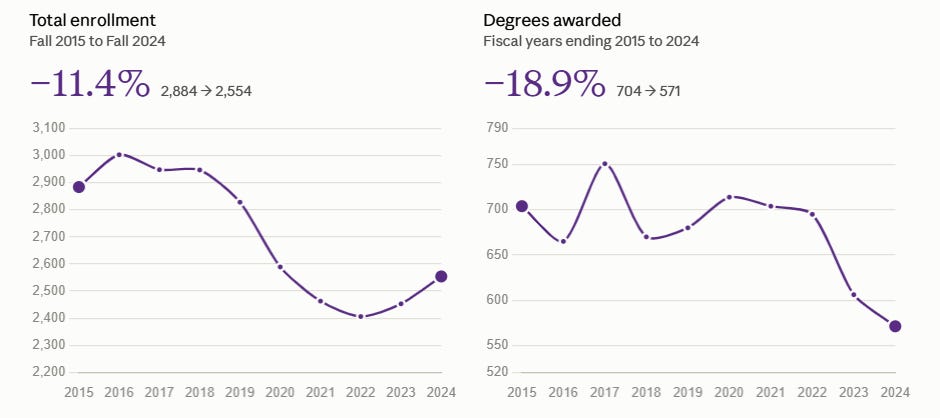
It shows that over the past decade, Furman’s total enrollment fell by more than 11%, from 2,884 in Fall 2015 to 2,554 in Fall 2024. We’ve reported figures like this before, but a different statistic from the Commission puts Furman’s situation in even starker relief.
If you look at degrees awarded each year over that same period, the decline is closer to 20%, with 704 degrees being awarded in 2014-15 and only 571 being handed out in 2023-24. Degrees trail enrollment by about four years, so this reflects the classes that arrived at the bottom of the slump.
This matters because it shows that Furman has not only been enrolling fewer students, but it has also been graduating even fewer. That confirms the trend Fitch flagged from a second direction. Indeed, degrees, which typically represent four years of tuition paid all the way through, are arguably an even better measure of the decline in net tuition revenue that Fitch was actually worried about.
Moreover, degrees are also what produce an alumni base. This finding shows that Furman’s alumni base has been shrinking even faster than its student population.
The Ugly
All of this looks even worse when you put Furman next to its peers.
South Carolina has a handful of private liberal arts colleges competing for many of the same students, in the same market, under the same demographic pressure. Four of the six increased degree production over the past decade. Furman’s decline is the steepest in the group. In fact, it’s roughly double the next worst.
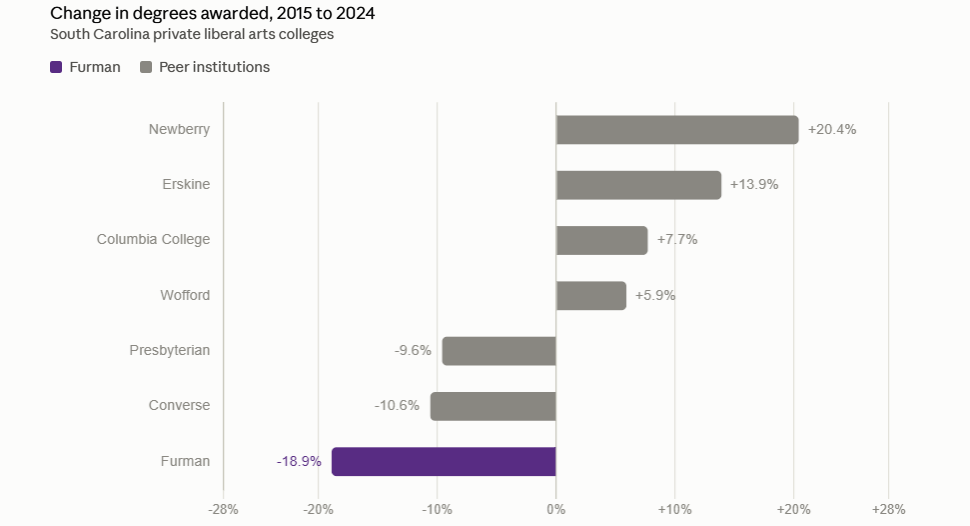
Worse still, our closest competitor has gone the other way entirely. Over the past ten years, Wofford’s degree output rose 5.9% while Furman’s fell 18.9%. The gap between the two schools is extraordinary: in 2014-15, Furman conferred 277 more degrees than Wofford, but in 2023-24, it conferred only 119 more.
This means Furman can’t blame the market. Demographics and macro trends are real, and they will keep putting pressure on small colleges for years to come. But South Carolina, and the Upstate in particular, is one of the most attractive regions in the country. The other schools here are expanding. Furman’s failures are because of its own policies.
The Takeaway
That sounds harsh, but it’s actually an optimistic reading. A university losing students to forces beyond its control has few moves to make. Furman’s problems are largely a byproduct of its own choices, which means it can make different ones.
The path forward is not easy, but it is straightforward. We need to replicate the large incoming freshman class we have coming to campus this month again in 2027, 2028, and 2029. Sustain it, and by the end of the decade Furman’s enrollment will have truly rebounded, with degrees conferred following behind.
That would be a real accomplishment, but it won’t happen on its own. It will take strong and determined leadership that understands the scale of what’s required and knows how to market what makes Furman great.
Which is why this year’s presidential search matters more than any other decision Furman has made in decades. Whoever replaces President Davis will inherit a decade of shrinkage that has only just begun to be reversed. The search committee must find someone who is prepared to take that challenge head on and help Furman continue to reverse the enrollment trends that Fitch raised concerns about one year ago.