


Welcome to the Data Din. A sharp, visual snapshot of key data about Furman University
Celebrating Valentine’s Day this past weekend, we thought we’d take a look at what dating and marriage have been like at Furman over the years.
At freshman orientation in 1995, President David Shi reportedly told students: Look to your left. Look to your right. One of you is going to marry someone you meet at Furman.
At the time, many believed Furman had an especially high rate of alumni who met and married. That belief gave rise to campus folklore, most notably the legend that couples who share their first kiss under the Belltower will eventually wind up at the altar. Today, the legend still endures.
Whether you choose to believe it is another matter. But the question remains: Was there ever truth to Furman’s reputation for producing marriages? And does it still hold today? Are Furman students and alumni more likely to get married than their peers at other schools?
The available data are limited, but what we do have suggests that Furman once did have a notably high marriage rate. In 2018, The New York Times reported on a study by the Equality of Opportunity Project tracking Americans born in the early 1980s. The study followed where they attended college, their parents’ income levels, and whether they were married in 2014.
According to that study, 65% of Furman students born between 1980 and 1984 – likely attended Furman between 1998 and 2006 – were married in 2014.
Nationally, this placed Furman 99th. We lost out to 13th ranked Samford with a 74% marriage rate. Wofford edged out Furman, ranking 80th with a 66% rate. But we ranked higher than Davidson (183, 61%), South Carolina (415, 54%), College of Charleston (439, 53%). For more details, see the chart below:
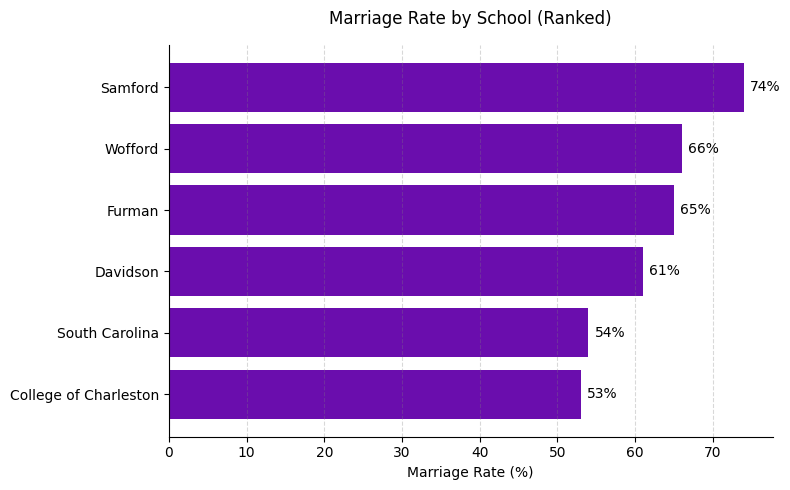
Of course, overall marriage rates do not prove that Furman students were marrying one another. But given the limited data available, it is the best indicator we have to evaluate the origins of the Belltower legend.
So what about today? Is Furman still producing relationships that lead to marriage? Is the Belltower magic still working?
The answer, unfortunately, is likely not — or at least not to the same extent.
In recent years, a handful of couples have gotten married shortly after graduation. But these cases appear to be the exception rather than the rule.
Fewer and fewer Paladins have been looking to meet a spouse on campus in recent decades. And by some accounts, many students have stepped away from dating altogether.
As early as 2001, Furman Magazine described the campus as experiencing a “dating vacuum,” defined by “two extremes: those who don’t date, and those looking to earn their ‘M.R.S.’ degree.” The article also noted a broader cultural shift, as students at Furman and across the country increasingly preferred “hookups” over traditional dating, contributing to a decline in campus dating culture nationwide.
Twenty-five years later, not much seems to have changed.
In 2021, a Furman student interviewed three different female students about dating at Furman. Each referenced Furman’s prominent hook up culture, leading the author to conclude that “because a lot of Furman’s culture revolves around hookups rather than dating, people sometimes feel pressured to do that.”
Furman is hardly unique in this trend. The transformation of dating culture has taken place on college campuses across the country. Still, it feels ironic — perhaps even a little disappointing — that a university known for its romantic legend, and frequently chosen as the setting for weddings and engagements, seems to be producing fewer such stories among its own students.
And yet, perhaps the Belltower legend still holds some quiet power.
A happy belated Valentine’s Day to all.
I think it does have to do with cultural attitudes. Women are waiting longer — or not aspiring to marriage at all. This is anecdotal of course, but if we look at coupling even earlier ie 70s and 80s there would be a higher rate. In my era, quite a few FU marriages occurred. And interestingly, almost all of them are still together. In the past, at least from a lot of males’ perspective, FU was literally a place where one would look for a mate. I think it also had to do with the “type” of girl one was looking for—ie worldview, social mores, achievement, ambition. That may be a reflection of a less-diverse milieu back then.