


Welcome to the Data Din. A sharp, visual snapshot of key data about Furman University.
This Friday, May 1, is the enrollment deadline for students in the Class of 2030 who will start on campus next fall. Across the country, high school seniors are choosing whether they want to commit to spending the next four years as Paladins. For Furman, the stakes could not be higher.
But first, a quick announcement: Today is Dins Day — Furman’s annual day of giving. FFSA is not officially affiliated with Furman, but we’d like to this occasion to ask for your support. If you are not already a paid subscriber, please consider supporting us today. You may also donate directly here.
Last year, Fitch cited declining freshman enrollment when it revised Furman’s bond outlook from stable to negative. They were right to do so.
Furman’s enrollment of 571 students in 2025 was down by more than 50 students from 2024 figure 621. And this wasn’t just one bad year. It is part of a much broader trend.
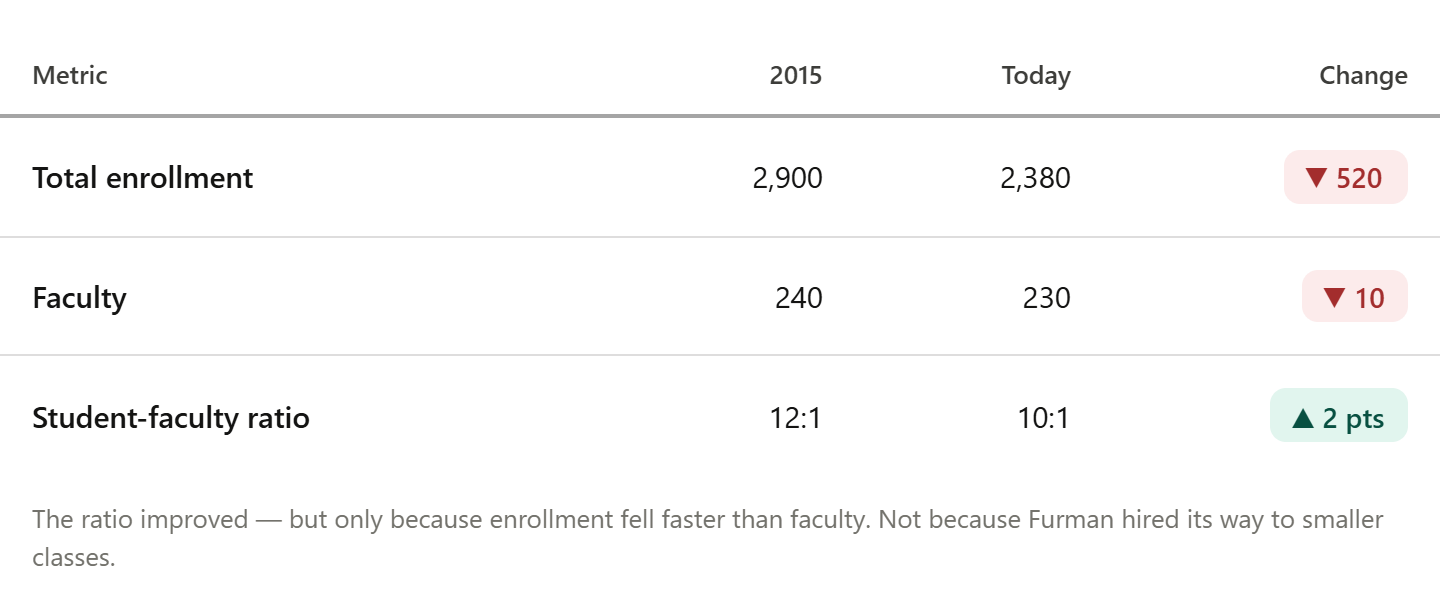
The truth is that the incoming freshman class has shrunk nearly every fall since 2014. Indeed, in the decade between 2015 and 2025, total enrollment has dropped from roughly 2,900 students to about 2,380. That’s a loss of more than 500 students, or approximately 17% of the student body.
We have reported on the reasons behind this trend: demographic decline, rising costs, a competitive regional market, and what higher-ed commentator Jeff Selingo has called Furman’s status as a “skip-over school” — caught between the elite liberal arts and cheaper state schools
Others have also reported President Davis’s acknowledgement of this problem and her efforts to reverse this trend, which have so far been unsuccessful. What students choose to do between now and the enrollment deadline will determine whether 2026 is the year that turns the tide.
In the meantime, we want to examine how Furman’s enrollment trends have consequences that are rippling through every part of the university.
Consider one of Furman’s favorite selling points: its student-faculty ratio. Visit Furman’s website and you’ll find “10:1” everywhere. It’s on the About page. It’s on the Rankings page. It’s certainly on the admissions materials and in the recruiting pitch. The message is clear: Furman offers an intimate, personalized education, and the 10:1 ratio is proof.
But it is worth examining how Furman achieved that 10:1 figure?
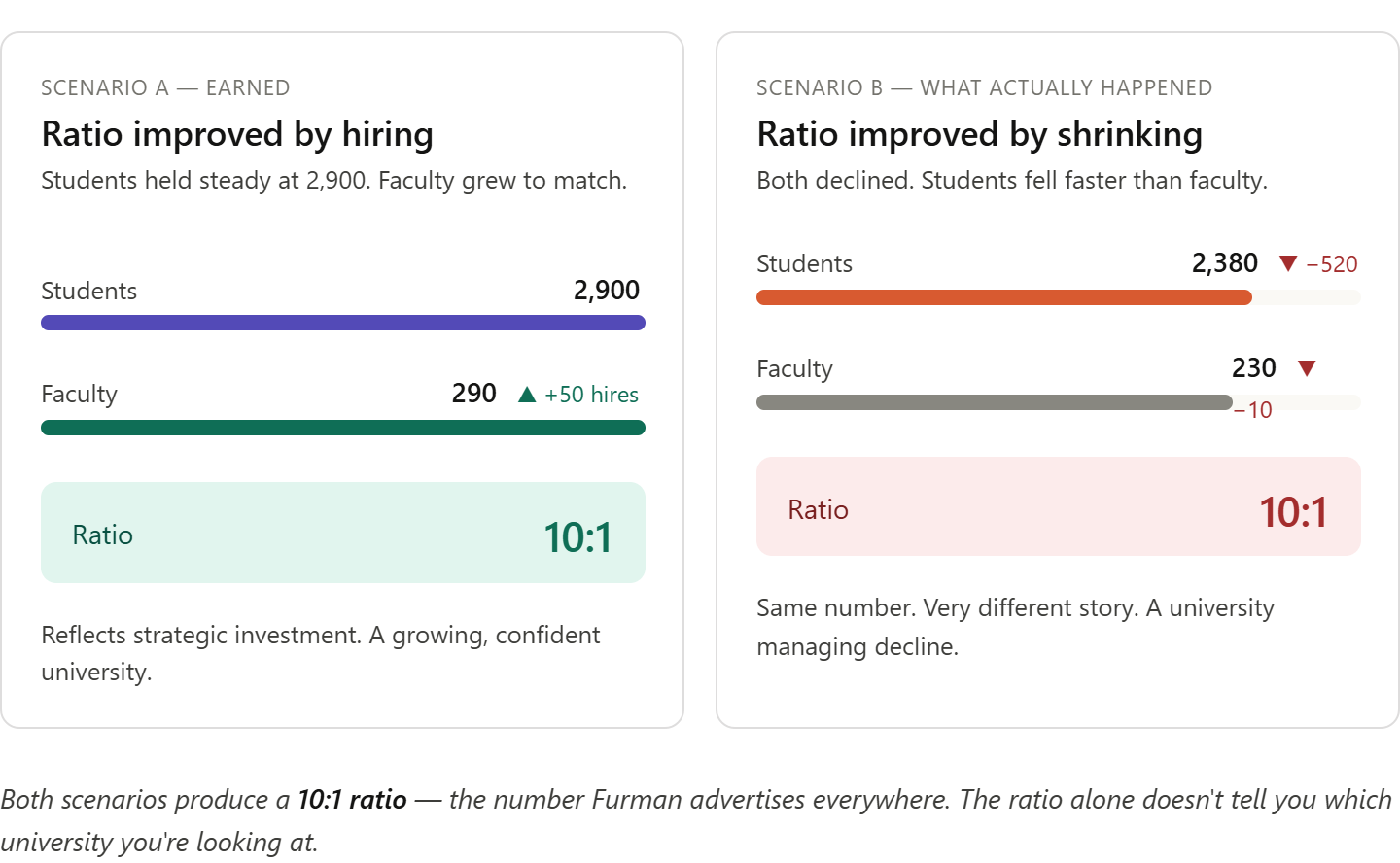
In 2015, the ratio was roughly 12:1, after all. Did Furman improve its ratio by strategically investing in faculty — hiring more professors, reducing class sizes, deepening the academic experience? That’s the narrative the administration would like alumni and prospective parents to believe.
But that’s not what the numbers say. The ratio didn’t improve because Furman hired more professors. In fact, data suggest that the faculty count has actually declined over the past decade — from roughly 240 to around 230 today.
The ratio only improved because Furman lost students even more quickly. Here’s a table to illustrate these trends:
This really matters – and it is one of the main problems with Furman’s current enrollment trends. They can easily obfuscate the reality of what’s really happening on campus.
Indeed, there is a difference between a ratio you earned by investing in your faculty and one you backed into by losing 500 students. The former reflects strategic strength. The latter indicates a floundering university attempting to manage its own decline.
But it doesn’t have to be this way. Furman has many peer universities with similar or higher student-faculty ratios that are maintaining or increasing their enrollments.
Colby College in Maine is one such example. They have a 10:1 student-faculty ratio just like Furman, but their enrollment has increased significantly in the past decade. In 2015 Colby enrolled roughly 1,850 students: Today it's at 2,412. That’s a gain of over 500 students in a decade, the mirror image of Furman's loss. Their formula was simple: invest heavily in the local community, build new dorms, expand facilities, and maintain a 10:1 ratio while growing.
Furman can and should be doing this. We have a 940-acre campus, world-class facilities, and an ideal location in one of the fastest-growing metro areas in the Southeast. There is absolutely no reason our alma mater should be shrinking.
At FFSA, we want Furman to grow because we want the university to succeed and because increasing the number of students represents an amazing opportunity for Furman to improve viewpoint diversity on campus.
Consider this: If enrollment grows, and Furman wants to maintain anything like its current 10:1 ratio, it is going to have to hire more professors. Not just to replace the ones who retire or leave each year through normal attrition, but to keep pace with the new students walking through the gates.
The math is simple. If Furman adds even 200 undergraduates over the next several years — a modest goal given that it has lost nearly 350 since 2015 — it would need roughly 20 additional faculty members just to hold the line at 10:1. Add in normal turnover — retirements, departures, contract endings — and the number of hiring decisions ahead of Furman could be very substantial.
Every single one of those hires is a critical opportunity.
At a moment when Furman has received an “F” from FIRE for its free-speech climate, and when students report high levels of self-censorship on campus, each new faculty position is a chance to change the intellectual composition of the university.
Other universities are committing to this sort of reform. A recent report from Yale, put together by an internal Committee on Trust in Higher Education, is
“urging each department, starting in 2026-27, to examine its ‘intellectual and methodological commitments’ as well as the ‘range of scholarly approaches represented on its faculty’ and ‘the diversity of perspectives in its curriculum.’”
Doing the same at Furman will require more than pro-free-speech rhetoric or a dramatic gesture. It will require the steady, cumulative effect of hiring people who bring genuinely different perspectives — political, methodological, philosophical — into Furman’s classrooms.
That all begins with President Davis improving enrollment in the incoming freshman class, which will be finalized this Friday. Stay tuned into our reporting to find out if the tide is turning.
I’m not convinced that Furman should grow. When I attended Furman, undergraduate enrollment was around 2,200. Everyone received a quality education, the faculty student ratio was low which enabled excellent student/teacher relationships; the campus was alive and thriving. Furman could have been larger, but it maintained high admission standards, which is a good thing. Furman does not need to be larger for it to a place where students can receive a quality education in a close-knit environment. Its size was one of its appealing features to me. Considering declining college enrollments across the country, perhaps this reduction in size is good thing.
I understand that increasing the diversity of thought within the faculty will be easier to achieve if the number is students and faculty are increasing. However, that should not be the reason for increasing student enrollment.
I continue to support your efforts to ensure all Furman students are comfortable expressing their opinions on campus and at increasing the diversity of political affiliations across the faculty. Furman must always welcome robust debate of all topics in society without fear of retribution from students or faculty. This is essential for students to obtain a quality liberal arts education.
Bob
Bob